Viser innlegg med etiketten no wave. Vis alle innlegg

mandag 29. mars 2010

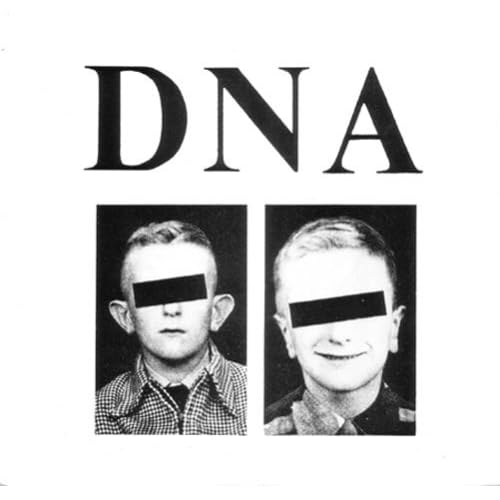
DNA - DNA on DNA


Arto Lindsay of DNA was originally invited to join Mars when they formed, but refused as he wanted to have 'his own band'. After a year or so, DNA was formed. Lindsay recruited performance-artist Robin Crutchfield on bass, and Japanese Ikue Mori on drums. Mori was originally just on vacation, but she became a full-time member. Like her peers, she was a non-musician; but she also couldn't speak english. Within weeks of their formation, they played their first show. DNA was featured on Eno's No New York. Sometime after that, Crutchfield left the band and was replaced by formed Pere Ubu-bassist Tim Wright.

DNA's style is unique. Arto Lindsay's metallic guitar crosses his hysterical squeals and Mori's unstructured drumming. It often sounds chaotic and improvised, but DNA practised their music to perfection, like many other no wave-artists. There's a lot of noise, but beneath that is absolutely genius compositions, complex and clever. It's like experimental pop-songs drenched with metallic noise.

DNA on DNA was released in 2004, compiled with, I think, help from John Zorn. It features their complete released material of 15 songs, as well as 17 songs, some new, some alt-versions, all in one hour.

DNA on DNA

tirsdag 16. mars 2010

Just Another Asshole: The LP (1981)


Just Another Asshole was a short-lived No Wave-oriented magazine, and with issue 5, they included this compilation. By 1981, the original No Wave-movement had passed, and the everyone-knows-everyone artist-society with it. This record, however, compiles many of the active post-No Wave artists into 77 tracks, each lasting less than a minute. It is highly experimental, and it is far between the gems, but it captures the No Wave-aestethic quite well, and it is indeed an interesting listen. Some known artists make appearances, like Sonic Youth members - short-time Sonic Youth keyboardist Anne DeMarinis contributes my favorite, "Radio Song" - Glenn Branca, Phill Niblock, ZE'V and Rhys Chatham, among others. Some pieces are excerpts from what is probably plays and poems. Some songs are pretty much jokes, like Phill Niblock's "Index Circa Seventy," playing one note for 30 seconds and another for 15. Michael Smith and A. Leroy contributes "The Smith-Leroy Comedy Team," which is a fake excerpt from a stand-up show.

It is chaotic, ridiculous and strange, and a lot of it isn't music. I highly recommend it.

Tracklisting
Just Another Asshole: The LP

søndag 14. februar 2010

Lizzy Mercier Descloux - Press Color (1979)


In the diverse No Wave-milieu, Lizzy Mercier Descloux managed to stand out as uniquely unique. Grown up in France she dropped out of art school to work in a punk record store, and visiting New York in 1975, she befriended Patti Smith and Richard Hell (of the Voidoids, Television and The Heartbreakers), and immediately found her place in the scene. She started playing with D.J. Barnes in Rosa Yemen, drawing from bands like Mars and DNA, but unique for their frantic guitars, and not least Lizzy's half-hysterical, french-english vocals.

On Press Color, Lizzy's first soloalbum, she would pursue a whole other direction. Half covers (including Arthur Brown's "Fire," Lalo Schifrin's "Mission Impossible" and "Jim On the Move," as well as a version of "Fever" where "fever" is replaced with "tumour"), half original material, Press Color was maybe inspired by James Black and the Whites' mutant disco, but it is far brighter. That is also what makes it so different from other No Wave. Her catchy guitar and upbeat basslines mixed with her smilingly charming french accent versus No Wave's attacking-the-audience aesthetic; but the No Wave influence is still loosely to be found. "Wawa" has that darkness of mutant disco, while "Torso Corso" would perhaps sound like a Teenage Jesus & the Jerks minus the noise and aggressiveness.

"No Golden Throat" is one of the catchiest songs ever.

Described by Richard Hell: "At 17 she was more sophisticated than anyone I'd known"; next she would prove herself by delving into world music, and combining it with her Press Color-sound, her second project would later become the genre-bending Mambo Nassau, that has its similarities to the Talking Heads' takes on world music, but yet is something to itself.

Press Color

Note: this is the 2003 reissue, and contains the 6-track Rosa Yemen EP, as well as a few outtakes, an alternate version of "Mission Impossible" and a collaboration with Patti Smith.

torsdag 11. februar 2010

Glenn Branca - The Ascension (1981)


I thought I perhaps should start out with the album that inspired the name of this blog - Lizzy Mercier Descloux's Press Color - but since I'm in a Glenn Branca-mood, I will start out with this instead.


Glenn Branca, originally having studied theatre in Boston, he moved to New York in 1976, where he soon got involved with the emerging No Wave-scene. Theoretical Girls, his first band, that he co-founded with Jeffrey Lohn of the N. Dodo Band, soon became one of the main forces of the scene; they were the most curious exclusion from Brian Eno's No New York-compilation. Lohn and Branca, being influenced by classical music, they always tried to impose classical elements in their otherwise No Wave noise rock.

Branca later got involved with Rhys Chatham, then the music director of New York's The Kitchen. Chatham recruited Branca as a member of his legendary Guitar Trio, which would inspire him to pursue a whole other direction. Guitar Trio's concept was a play on the aftersound of alt-tuned, layered guitars, which would produce howling sounds that could be mistaken for all kinds of things - many mistook it for a noise-drenched background vocal. Glenn Branca would take that sound, combine it with his noise-classical-concept, and go on to compose what would become Lesson No.1 For the Electric Guitar, released in 1980.

The Ascension, usually considered Branca's masterpiece, continues in the direction of Lesson No.1, combining noise-classical elements with alt. guitar tunings, and layered guitars producing aftersound. It opens with "Lesson No.2"; not really similar to "Lesson No.1," but rather draws from "Dissonance," the other track on the Lesson No.1 EP. It is not harmonic, but noisy. It starts out with a brutal bassriff, then moves on to spurts of metallic noise. "The Spectacular Commodity" picks up where "Lesson No.2" left, but soon moves into a more complex composition. After a while it really takes off, beginning an eternal, mesmerizing crescendo - resembling that of "Lesson No.1" - a crescendo that after several minutes, its ending seems forced, but fitting. I consider the following 3-minute "Structure" as a sort of interlude. It starts pleasantly, in good contrast to the epic of "The Spectacular Commodity," but soon, it, too, transform into noise. Another eternal crescendo, "Light Field (In Consonance)" follows. Drawing similarities to "The Spectacular Commodity," it lacks the noise part, it is more repetetive, and it is generally lighter; it sounds like a light field in consonance. Compared to "The Spectacular Commodity" it is fairly accessible, so it's probably better to compare it to "Lesson No.1." The ending track of this, by now, you-should-expect-this-to-having-reached-its-peak-of-epic album, is the title track, "The Ascension"; "the song that redefined the wall of noise." It is repetitive and noisy and magnificent, with multiple guitars layered to sound like they're some sort of tacky organ, droning its way through its 13 minute tar-like substance, while absorbing your light. When it finishes up, it leaves you empty, amazed.

What I find very inspiring about this album, is how ahead of its time it was. This is basically post-rock, or at least something very related, and it must certainly have been very inspiring for the crescendo-post-rock bands, type Godspeed you! Black Emperor, that emerged some 10-15 years later. I find No Wave endlessly interesting, and I consider Branca to be the most talented musician of the scene. After The Ascension, he moved on to composing contemporary classical music, as a natural progression from "The Ascension." His Symphonies are something completely different than his work with Theoretical Girls, Lesson No.1 and The Ascension, but they still draw from the same influences: noise-classical and guitar aftersound, often including up to 100 guitars. After 29 years of symphonies, however, Branca is releasing The Ascension: The Sequel February 27th. I am very excited, and a bit scared.

Note: the above artwork is not the The Ascension-artwork, but a similar piece by the same artist - Robert Longo.

The Ascension